Equality and Human Rights Commission (EHRC) — UK National Human Rights Institution
Status: 🔴 Under the leadership of Baroness Kishwer Falkner (2020–2025), the EHRC was weaponized against trans rights despite its statutory mandate to protect equality. Exposed for misleading GANHRI about trans healthcare work and for cherry-picking UN criticism.
Since the EHRC is an institutional player, with leadership that changes over time based on governmental changes in the UK, it has done good work on trans rights in the past, and may again in the future. It is important to be aware of the timeframe of any of their content. It may, in the future, become fit for purpose again as a human rights organization, but at the time of writing, this has not happened and all of its output on trans people should be held suspect. The content on this page will mostly be from late 2020 to the present, as that is the term of the current leadership. {.is-warning}
Overview
The Equality and Human Rights Commission (EHRC) is a non-departmental public body (NDPB) in Great Britain, established by the Equality Act 2006. It is responsible for promoting and enforcing equality and non-discrimination laws, including the Equality Act 2010. As the UK’s A-rated National Human Rights Institution (NHRI), it is accredited by the Global Alliance of National Human Rights Institutions (GANHRI).
Under Baroness Kishwer Falkner’s chairmanship (December 2020 – November 2025), the EHRC underwent a significant shift from its previous trans-inclusive stance toward a gender-critical agenda, drawing widespread criticism from civil society, UN bodies, and GANHRI itself.
Lack of Real Independence
While some of the problems of the EHRC’s independence are clear, and fairly well-known, it may be much worse than it appears. The first aspect of it is the fact that the chair and the commissioners are appointed by a government minister. But, it’s also been deliberately politicized, being treated as if it’s a branch of government.
Timeline of Anti-Trans Actions
-
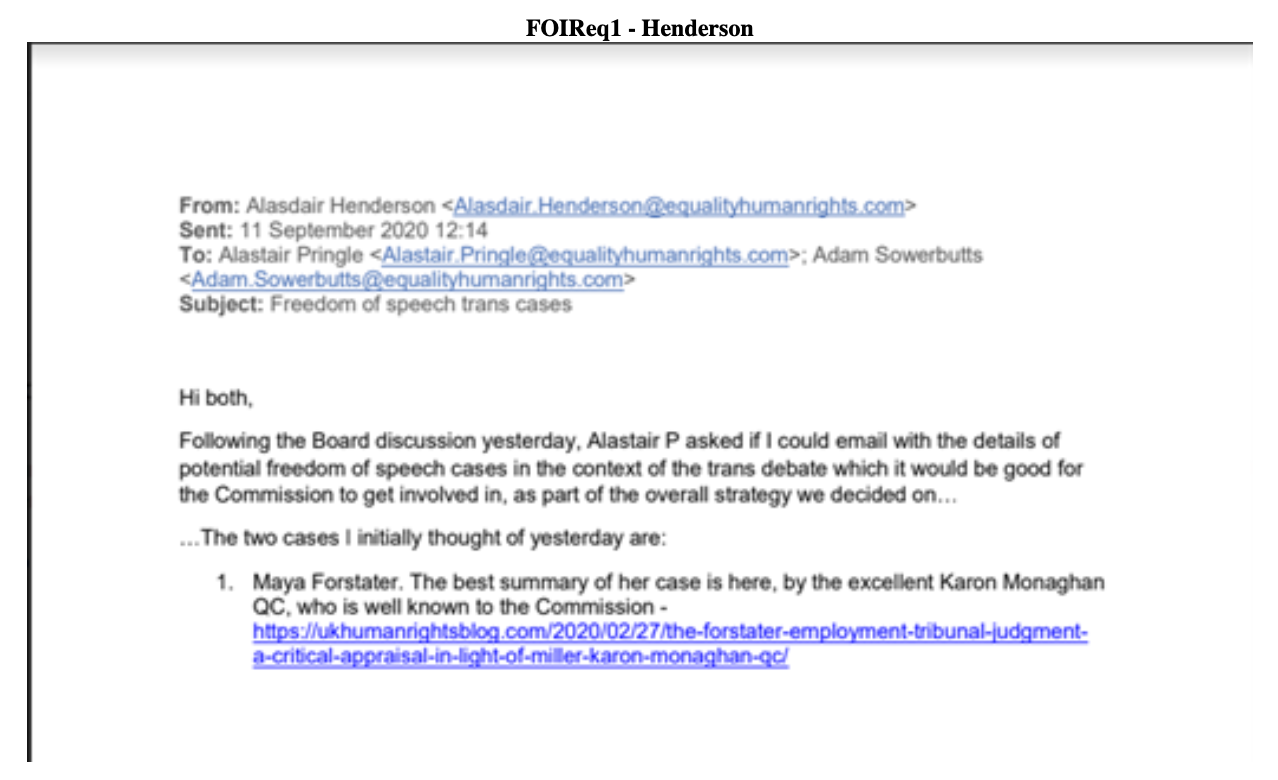
Alasdair Henderson emails colleagues seeking cases the EHRC can intervene in on the basis of free speech. Subject line “Freedom of speech trans cases”.
-
December 1st, 2020: a. The Conservative government’s minister for women and equalities, Liz Truss, appointed Kishwer Falkner, Baroness Falkner of Margravine as its chair. appointment b. The original ruling, now overturned, in Bell v. Tavistock was announced, banning trans children from accessing puberty blockers on the NHS. c. An investigation is revealed into Alastair Henderson’s social media activities.
-
8th February, 2021: a. Baroness Falkner writes to “gender critical” groups seeking their input on transgender issues, despite these groups being clear hate groups. See “Platforming of ‘Gender Critical’ Groups” below. b. Melanie Field invites Stonewall and Williams’ Fair Play For Women to give input on trans rights.
-
March 2021: The EHRC withdraws from the Stonewall Diversity Champions program. The program had reviewed organizational policies to ensure they were widely inclusive.
-
April 2021: The EHRC intervenes in Forstater v. GCD, a major Gender Critical case, arguing that gender critical beliefs are protected because they are “worthy of respect in a democratic society is such as to exclude only extreme beliefs; for example, a belief in “racial superiority” (Code of Practice, §2.59) or a “cult involved in illegal activities” (Explanatory Notes, §52).”[1] They were criticized for this position by trans people.[2] The EHRC was represented by Karon Monaghan KC, a seemingly gender critical lawyer.
-
May 2021: Baroness Falkner gave an interview to the Times, a Rupert Murdoch publication, she argued that “Women must have the right to question transgender identity without being abused, stigmatised or risking losing their job”. She was announcing the EHRC’s intervention into Maya Forstater’s appeal of an initial ruling by an employment tribunal. With the EHRC’s support, Forstater was able to win a ruling that her views were protected under UK law.
-
13th of May, 2021: Multiple LGBTQ+ organizations write to the EHRC.[3] They said:
We are disappointed that, despite the realms of possibility to improve LGBTQ+ people’s lives and our access to our human rights, the EHRC has driven forward very little for our communities in recent years. Against that backdrop of a lack of support for LGBTQ+ people, we are frustrated that you then chose to intervene in a case to say that so-called ‘gender critical’ beliefs should be a protected philosophical belief.
-
28th of May, 2021: Baroness Falkner responded on behalf of the EHRC, claiming the intervention was merely about protecting freedom of belief.
-
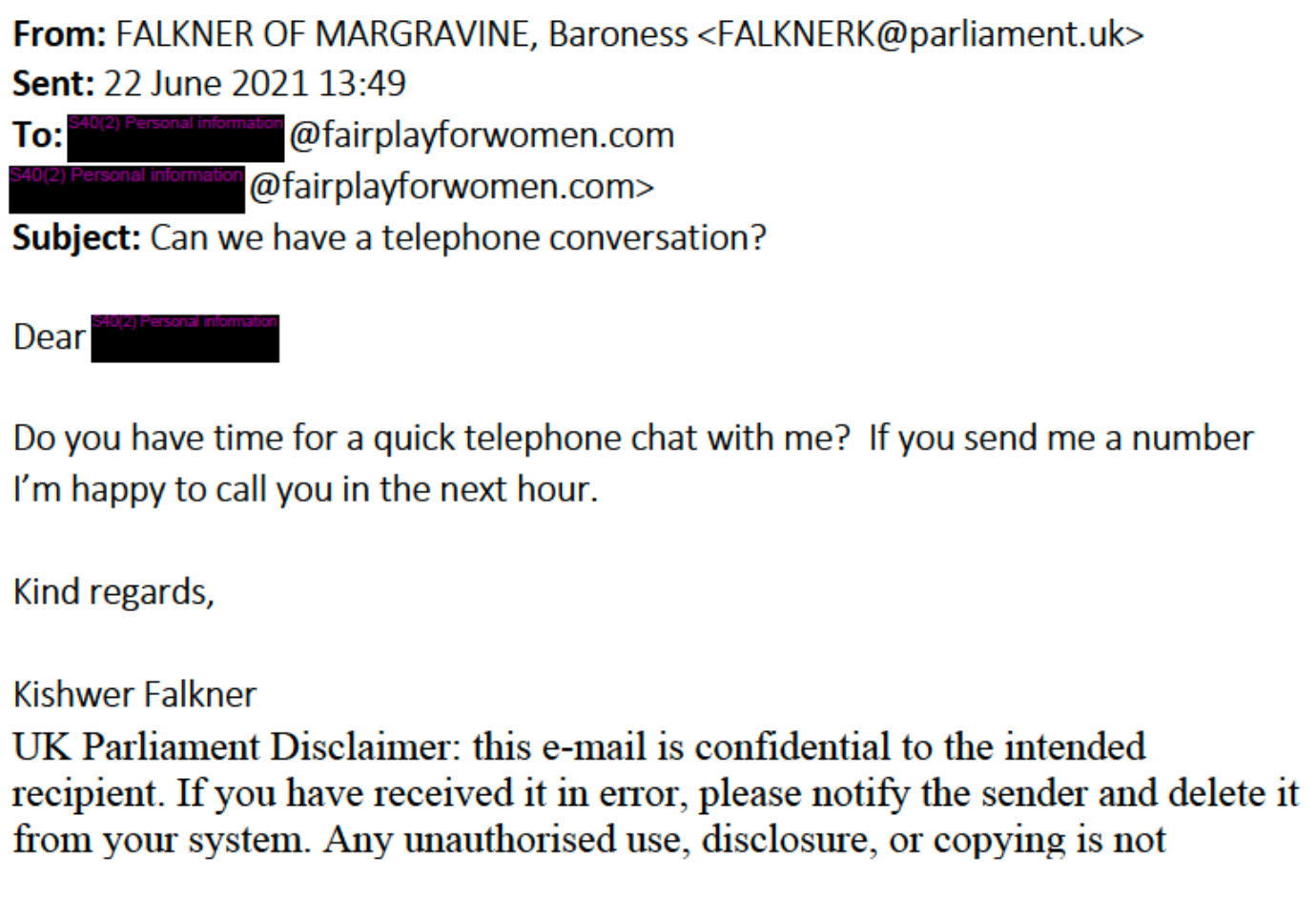
Baroness Falkner writes to someone at Fair Play for Women asking for a “quick call”. She uses her Parliamentary email, which might be an indication she’s trying to hide her activities from Freedom of Information Act requests.
-
22nd January, 2022: The EHRC writes an open letter opposing Scotland’s effort to reform the Gender Recognition Process, claiming consequences relating to data, sport, women’s services, and criminal justice.[4]
-
26th January, 2022: a. The EHRC release a position statement on banning conversion therapy, advocating for banning conversion therapy for gay people only, but not transgender people.[5] b. The LGBT Foundation severed ties with the EHRC over their transphobic stances.[6] c. Liberty, Stonewall, Mermaids, and 20 other LGBTQ+ organizations call for the EHRC to be investigated as a National Human Rights Institution.[7][8]
-
2nd February, 2022: Vice reported that EHRC had met privately with anti-trans hate groups, including LGB Alliance and Nicola Williams of Fair Play For Women.[9]
-
4th February, 2022: VICE reports that EHRC staffers are quitting and facing discipline for objecting to changes at EHRC on trans rights. Staff also report documents they created being edited to be transphobic.[10]
-
4th April, 2022: The EHRC publishes guidelines for Single Sex Spaces, ignoring trans rights, and implicitly insisting trans people are their sex assigned at birth.[11]
-
23rd November, 2022: The EHRC meets for their monthly board meeting to discuss proposed Amendments to the Equality Act of 2010.[12] a. Alasdair Henderson did not declare any interests, despite the fact that he had worked on the Bell v. Tavistock case. b. Under Declaration of Interests, commissioners [David Goodhart] and Akua Reindorf declared interests, but the chair ruled they were not reasons to recuse. Reindorf had been instructed by LGB Alliance. {.is-warning}
-
28th February 2023: Extraordinary meetings of Scotland and Wales Committees of EHRC, rejecting the organization taking up making recommendation on reforming EA2010. They raise concerns that it will be used to roll back trans rights.[13][14]
-
30th March 2023: EHRC board finalized letter to reform EA2010, legalizing discrimination against trans people.[15]
-
3rd April 2023: Baroness Falkner sends the letter to government redefining “sex” as “biological sex” in the Equality Act.[16]
Withdrawal from Stonewall’s Diversity Champions
Shortly after Falkner’s appointment in 2021, the EHRC withdrew from Stonewall’s Diversity Champions scheme, a move critics argued signaled institutional abandonment of LGBT+ workplace standards.
Forstater Intervention
The EHRC intervened in Forstater v Centre for Global Development Europe to support the position that gender-critical beliefs are protected philosophical beliefs under the Equality Act 2010 — a case that has become a cornerstone of anti-trans litigation strategy in the UK.
GANHRI Special Review (2023–2024)
In 2023, the EHRC faced a special review by GANHRI’s Sub-Committee on Accreditation after concerns were raised about its commitment to human rights. The UN Independent Expert on Sexual Orientation and Gender Identity (IE SOGI) also called the EHRC out for its failures on trans rights.
In its defense to GANHRI, the EHRC claimed it was developing a “package of work” on trans healthcare in partnership with civil society organizations. However, a 2026 FOI investigation by The Alliance for Counselling and Psychotherapy (TACC) revealed:
- The work was a “scoping and feasibility” exercise with no allocated budget
- Six staff members were assigned but no records exist of any engagement with trans CSOs
- Falkner personally oversaw the project
- The only relevant public output on trans healthcare was recommending that conversion therapy should include “reconciling a person to their biological sex”
Despite these misrepresentations, GANHRI closed its special review in 2024, allowing the EHRC to retain its A-rating.
Misrepresenting the UN Independent Expert (2023)
Following the EHRC’s April 2023 letter advising the redefinition of “sex” as “biological sex” in the Equality Act, Victor Madrigal-Borloz, the UN Independent Expert on protection against violence and discrimination based on sexual orientation and gender identity (IE SOGI), conducted an official country visit to the UK (24 April – 5 May 2023). His end-of-mission statement was unequivocal:
“The Independent Expert was particularly alarmed by a 3 April 2023 letter from the Equalities and Human Rights Commission (EHRC) to the Minister for Equalities, by which it advised that defining the term ‘sex’ as ‘biological sex’ under the Equality Act would ‘bring greater legal clarity’ to the implementation of the Act.”
He noted that the EHRC’s own Scotland Committee had warned the proposed change “could diminish trans people’s rights” and that pursuing it posed an “existential risk” to the EHRC’s perceived political independence.
The EHRC subsequently referenced the IE SOGI in public statements — but selectively omitted the word “alarmed” and the substance of his criticism. A July 2026 investigation by TACC revealed the full extent of this cherry-picking, showing the EHRC had quoted only supportive or neutral portions while burying the UN’s explicit condemnation.
The same investigation also published the board minutes timeline, revealing the decision to push for redefining “sex” had been pre-decided months before the formal consultation:
- 23 November 2022 (99th Board Meeting): Commissioners discussed “legal and policy issues” around redefining “sex” and its interaction with the Gender Recognition Act
- 18 January 2023 (109th Board Meeting): The Board formally agreed to advise the Government, subject to a further meeting on communications and stakeholder strategy
- 28 February 2023 (Scotland Committee): Scotland Committee formally objected, warning of “existential risk” to the EHRC’s independence
- 30 March 2023 (110th Board Meeting): Finalized the letter and communications strategy
- 3 April 2023: Letter sent to Minister for Equalities
This timeline shows the decision preceded the Scotland Committee’s formal input, and its objections were noted but not acted upon.
Single-Sex Spaces Guidance (2025)
Following the UK Supreme Court’s November 2024 ruling narrowing the definition of “sex” in the Equality Act, under Mary-Ann Stephenson the EHRC published interim guidance calling for trans people to be banned from single-sex facilities consistent with their gender identity. The guidance was criticized for:
- An initial consultation period of only two weeks, called “rushed” and potentially “unlawful” by Liberty
- Expanding the Supreme Court ruling beyond its scope
- Causing real harm — trans people reported developing urinary tract infections from fear of using toilets
- Falkner dismissing these concerns by telling trans people to “respond to our consultation”
The consultation was later extended to six weeks following legal challenge.
Legal Challenge by Liberty
In 2025, the National Council for Civil Liberties (Liberty) launched a legal challenge against the EHRC’s consultation process, arguing it was unlawfully rushed.
Mary-Ann Stephenson’s Select Committee Grilling (June 2026)
In June 2026, Chair Mary-Ann Stephenson appeared before the Women and Equalities Select Committee to defend the EHRC’s guidance on single-sex spaces following the Supreme Court ruling. MPs Nadia Whittome and Sarah Owen rigorously scrutinized the practical implications of the guidance. Key exchanges from the hearing, covered by PoliticsJOE, included:
On the risk to trans people:
When challenged that the EHRC’s own impact assessment found trans people “could face a disproportionate risk of violence and sexual assault” from the code, Stephenson replied:
“I think we recognize that there are certain elements of what we now understand the law to be which does disadvantage trans people compared to what they thought the law was.”
On ‘policing’ toilets:
Stephenson repeatedly assured the committee the EHRC does not expect service providers to check who uses toilets:
“We specifically say we’re not expecting service providers to police the use of toilets.”
However, when pressed on what enforcement exists if someone uses the ‘wrong’ toilet, Stephenson acknowledged the law falls on service providers, not individuals.
She also admitted there is no criminal offense for using the wrong space.
On ‘common sense’ and physical appearance:
MP Whittome directly challenged Stephenson on the guidance’s language allowing staff to consider “physique, physical appearance, behavior.” Asked to define specific elements of physique and appearance, Stephenson replied:
“What’s required here is to take a common sense approach.”
She was unable to provide specific, objective criteria for staff to use, instead relying on undefined “common sense.”
On trans patients in hospitals:
MP Owen raised the case of “Terraina,” an 83-year-old trans woman who discharged herself from hospital out of fear of being placed on a men’s ward. Stephenson conceded this was undignified but used the term “differences of sexual development” rather than “intersex.”
Impact: The hearing was widely shared and criticized for exposing the incoherence of the EHRC’s position.
Key Controversies
- No meeting records with trans groups: Despite claiming to engage with trans communities, FOI requests showed the EHRC had no meeting minutes with trans civil society organizations in five years
- Conversion therapy stance: The EHRC recommended that conversion therapy practitioners be allowed to continue “reconciling a person to their biological sex” for children and young people
- Staff criticism: Falkner’s predecessor and EHRC staff publicly criticized the Commission for becoming politicized and transphobic
Platforming of “Gender Critical” Groups
The EHRC under Falkner has gone out of their way to engage gender critical groups on transgender issues. This is a strange approach, since it is hard to imagine it being considered appropriate for any other group protected by civil rights legislation to have their rights balanced against the demands of hate groups, including having the civil rights watchdog actively soliciting their input.
Baroness Falkner sent the following email (emphasis added):
Dear Kate and Bev,
Apologies to email you out of the blue. I have a time limited request which I wondered if you could help with. Tomorrow we are holding a briefing session for our board on issues relating to trans people. We had asked three organisations with an interest in the debate on balancing trans peoples rights with other peoples rights to provide short (3 minutes) videos explaining their positions and policies. Unfortunately one of the organisations we asked (Women’s Place UK) have been unable to provide a video at the last minute. I know you have recently been in touch with colleagues at the Commission and will soon be meeting with Melanie Field. She has asked me to contact you to enquire whether you would be able to provide a short three minute video outlining LGB Alliance’s main policy positions and why you think it is important to separate trans and LGB issues for us the share with our board at tomorrows session.
Both Women’s Place UK and the LGB Alliance are anti-trans organizations. The chair of a civil rights watchdog should not be coordinating submissions of hate groups.
Capture of Labour
The EHRC investigation into antisemitism in the Labour Party, combined with the Forde report, was weaponized by the Labour Right to purge the party’s left. The result was a Labour Party that moved towards the Conservatives on trans issues — exemplified by Wes Streeting making the ban on puberty blockers permanent.
Commissioner Alasdair Henderson would have been working on Bell v. Tavistock at nearly the same time he was investigating Labour for the EHRC, and looking for free speech cases to take up in relation to trans people.
In 2024, the newly-elected Labour government extended Baroness Falkner’s term in office.
FOIA Documents
Freedom of Information requests have revealed the extent of EHRC’s correspondence with anti-trans groups.
FOIA Ref 10902548 (May 2025)
This FOIA release included:[17]
Annex A: Sex Matters Correspondence Extensive correspondence between the EHRC and Sex Matters, Maya Forstater’s anti-trans organisation.
Annex B: LGB Alliance Correspondence Correspondence between EHRC and LGB Alliance, showing regular engagement on trans policy matters.
Annex C: Commissioner Code of Conduct Documents relating to commissioner conduct standards.
Kate Harris House of Lords Invitation
FOIA documents revealed that Kishwar Falkner invited Kate Harris (LGB Alliance co-founder) to the House of Lords to celebrate the Equality Act 2010 anniversary.[17:1]
This demonstrates direct access between anti-trans organisation leadership and the UK’s equality regulator, while trans stakeholder groups were excluded from EHRC consultations.
Documents available: EHRC FOIA Documents
Leadership
| Chair | Term | Notes |
|---|---|---|
| David Isaac | 2016–2020 | Previously chaired Stonewall |
| Kishwer Falkner | 2020–2025 | Shifted EHRC to gender-critical agenda |
| Mary-Ann Stephenson | 2025–present | Former Director, Women’s Budget Group / Fawcett Society |
Known Anti-Trans Collaborators
- Kishwer Falkner, Baroness Falkner of Margravine
- Alasdair Henderson — EHRC trustees vice chair, also involved in Bell v Tavistock; listed as director/trustee of Lawyers’ Christian Fellowship when they were working with the ADF, an anti-LGBTQ+ hate group[18]
- Kemi Badenoch[19]
- Melanie Field — executive director of strategy
- Akua Reindorf
- Liz Truss
See Also
- Translucent UK — Investigations exposing the EHRC
- EHRC undermined by pressure to support No 10 agenda, says ex-chair
- Kishwer Falkner — Former EHRC Chair
- Maya Forstater — Central figure in the gender-critical belief case
Sources
- TACC: How the EHRC rewrote its dispute with the United Nations
- TACC: “Trust me, Bro”, or the tale of Falkner’s forgotten homework
- PinkNews: EHRC chair says trans guidance could become law within months
- The Guardian: Transgender people may be asked about gender status in workplace
- IE SOGI: UN Statement on UK EHRC
- GANHRI SCA Report 2024
- EHRC response to GANHRI
- TransActual: GANHRI Submission
- Outpatients: EHRC Code of Practice update
- Centre for Mental Health: Joint letter
- i-Base: HIV treatment impact of EHRC guidance
- EHRC: Appointment of new Chair
- UK Parliament: Appointment of the Chair of the EHRC
Related Pages
- Kishwer Falkner — Former EHRC Chair
- Alasdair Henderson — EHRC trustee vice chair
- Akua Reindorf — EHRC commissioner
- Maya Forstater — Central figure in the gender-critical belief case
Major LGBTQ+ organisations spark international review of the EHRC ↩︎
Staff Are Quitting Britain’s Equality Watchdog the EHRC Due to ‘Transphobia’ ↩︎
Letter to Minister for Women and Equalities on the definition of ‘sex’ ↩︎
EHRC FOIA Ref 10902548 — Correspondence annexes released May 2025 ↩︎ ↩︎
Translucent: The links between the EHRC, Alliance Defending Freedom & Christian Concern ↩︎